
FRAUD FORENSICS
Catch the document that shouldn't pass.
Every document is screened for manipulation before it reaches your policy: metadata, structure, typography, arithmetic, chronology. Every finding cites its evidence.
THE FORENSIC SUITE
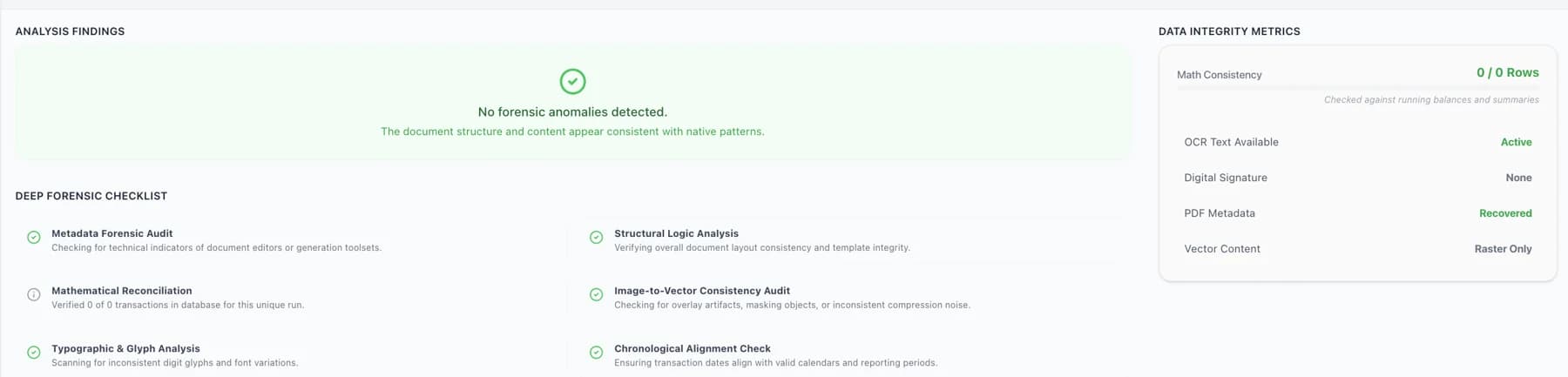
Six ways a document confesses.
Every page runs the full suite, automatically. Each check hunts a different class of manipulation, and a clean pass on one doesn't excuse the others.
METADATA FORENSIC AUDIT
The technical fingerprints of document editors and generation toolsets, read from the file itself.
STRUCTURAL LOGIC ANALYSIS
Layout consistency and template integrity: the page that no longer matches the document it claims to be.
MATHEMATICAL RECONCILIATION
Every transaction recomputed against running balances and summaries. Figures that don't add, caught.
IMAGE-TO-VECTOR CONSISTENCY AUDIT
Overlay artifacts, masking objects, inconsistent compression noise: the residue of an image edit.
TYPOGRAPHIC & GLYPH ANALYSIS
Inconsistent digit glyphs and font variations where new numbers were set over old ones.
CHRONOLOGICAL ALIGNMENT CHECK
Transaction dates checked against valid calendars and reporting periods. Time that doesn't line up.
EVIDENCE
Findings you can cite.
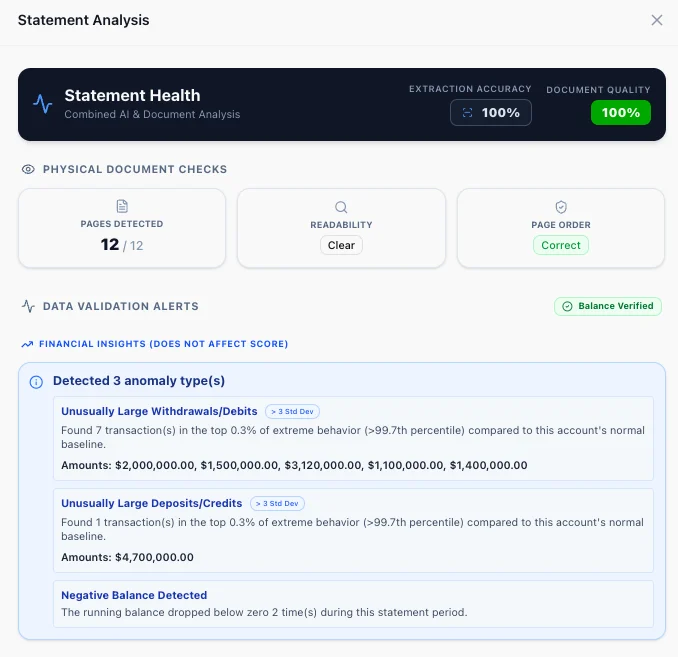
Every flag comes with the evidence behind it: the exact page, the region, and the reason the check fired. Written so credit and risk teams can act on it directly, and auditors can follow the trail later.
- The exact page and region
- The reason the check fired
- A trail auditors can follow
3×
Statement fraud caught in the first 90 days
ALON CAPITAL
OPERATING PROOF
Fraud screening runs on every application.
Not a premium add-on. Every document, every page, screened before your policy ever sees the data.
QUESTIONS
Document fraud detection, answered.
What is document fraud detection for lending?
Document fraud detection screens loan documents (bank statements, payslips, IDs) for forgery and tampering before they reach a credit decision. Floowed runs this forensically on every application, catching the altered or fabricated document that would otherwise pass.
How does Floowed detect a forged or altered bank statement?
Floowed runs six forensic checks on every document: a metadata forensic audit, structural logic analysis, mathematical reconciliation, an image-to-vector consistency audit, typographic and glyph analysis, and a chronological alignment check. Together they expose the ways a tampered document gives itself away.
What kinds of document fraud does Floowed catch?
Altered numbers where new figures were set over old ones (leaving glyph and font inconsistencies), edited PDFs with telltale metadata, statements whose math doesn't reconcile, balances that don't carry, and dates that don't line up chronologically.
Does fraud screening run on every application?
Yes. Fraud screening runs automatically on every application, not as a separate manual step or an occasional spot check.
Can Floowed explain why it flagged a document?
Yes. Every finding is citable: the exact page and region, the specific reason the check fired, and a trail an auditor can follow, not an unexplained score.
Has Floowed caught real fraud?
Yes. In its first 90 days at Alon Capital, Floowed caught 3× more statement fraud than the lender's prior manual review.
How is this different from a fraud score?
A fraud score gives you a number; Floowed gives you the evidence. It examines the document itself and returns explainable findings tied to the exact page and region, so your team can act on a defensible reason rather than a probability.
ONE PLATFORM
One platform. The whole decision.
The file is screened. Here’s what can run on it.
Put your trickiest file under it.
Bring the one that got through. See what it confesses.