
THE DECISION ENGINE
What actually decides the case.
A decision is rarely a checkbox. Underneath one sits the evidence it was given, the figures worked out from that evidence, the gates it has to clear, the score it is graded on, and a different outcome for every combination. All of it yours to set.
WHY THEY’RE STILL MANUAL
Two problems, and most tools only solve one.
You need both solved or the decision stays on somebody’s desk. Most of the market has taken the first one.
PROBLEM
The evidence problem
Plumbing. Genuinely hard, and a lot of products solve it.
- It sits in more than one placeA system, a sheet, an inbox, a folder. Almost everything that decides something assumes it all arrives on one screen, already structured.
- At least one of those places isn’t a systemA spreadsheet somebody maintains. A document that arrives as a photo. An answer that only exists in somebody’s head until you ask. Where most tools stop and most of the work starts.
PROBLEM
The logic problem
Not plumbing. This is the half almost nothing solves.
- The rule isn’t really a ruleIt has thresholds, exceptions, and a band where it depends. Nobody wrote it down because the person who knows it has always just known it, which is fine until they are on leave or they leave.
- The answer isn’t yes or noIt is how much, on what terms, with which conditions, or which of four grades. A tool that only routes an approval cannot hold that, so a person holds it instead.
FLOOWED IS BOTH HALVESThe gathering and the chasing solve the first. The policy solves the second. Either one on its own leaves the decision exactly where it started, on somebody’s desk.
INSIDE ONE POLICY
Every gate, weight and band is yours to set.
Those situations are simple to describe. What decides them is not. This is one policy in full, and the same five layers sit under all of them.
- 01
Data elements
The facts, pulled from wherever they live. Invoice dates and amounts from accounts, the filed accounts as a document, open disputes from the CRM, the registry record.
- Days overdue, per invoice
- Turnover, last filed year
- Open disputes, count and value
- 02
Synthetics
Facts the business does not hold anywhere, computed from the ones it does. This is usually where a policy stops being possible in a spreadsheet.
- Average days to pay, rolling 12 months
- Trend in order value, quarter on quarter
- Disputes as a share of orders
- 03
Hard gates
Pass, fail, or unknown, on any element or synthetic, at thresholds you set. A failed gate can stop everything regardless of how good the score is.
- Nothing more than 60 days overdue
- No unresolved dispute above 5,000
- Registry status active
- 04
Scorecard
Weighted attributes producing a score and a grade. You set the weights, the bands, and what each band is allowed to do. Bring your own model if you have one.
- Payment behaviour · 40%
- Financial strength · 35%
- Relationship length · 25%
- 05
Outcomes
Not one verdict. Every combination of grade and gate gets its own, and each can carry conditions rather than a flat yes or no.
- A or B · approve to the requested limit
- C · approve at half, review in 90 days
- D or any failed gate · refer to a person
IN THE PRODUCT
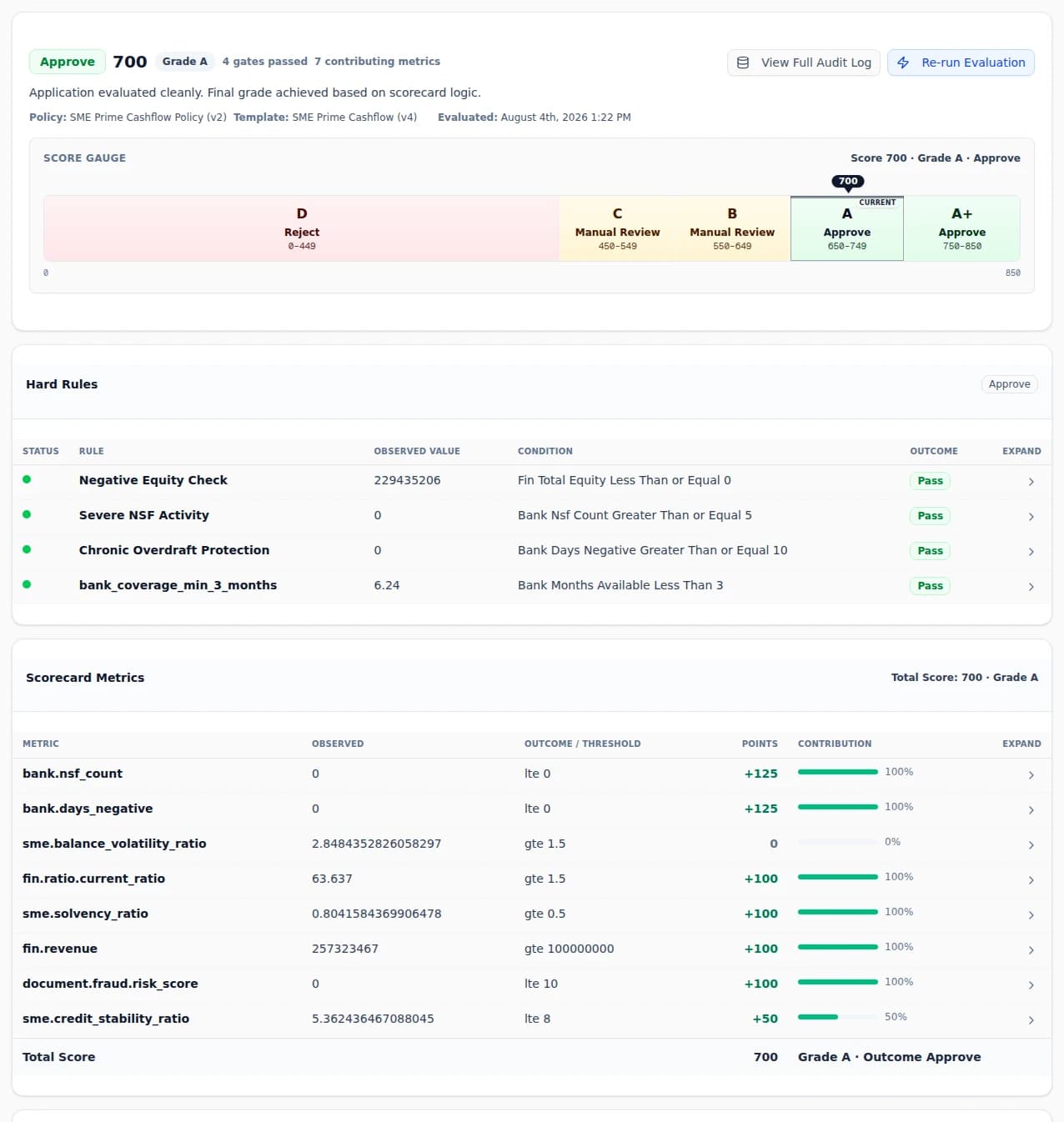
What a decided case looks like.
Every gate that was checked, what it was checked against, and where each number came from. Open any line and the evidence sits underneath it.
GETTING ONE LIVE
Describe it. Check it. Test it. Then publish.
Usually an afternoon for the first one, and considerably less for the next, because the integrations are already there.
- 01
Describe it in the Decision Builder
Tell it the decision you want made, the way you’d brief a new joiner: which systems hold what, which sheet has the rest, who has to confirm, and what should happen at the end. It drafts the policy from that, including the gates it thinks you meant.
- 02
Read it back before it runs
The draft comes back as a workflow, not code: every step laid out in order, every gate saying what it checks and where it looks, every weight a number you can move, every band yours. Add the exception your business has, delete the one it invented.
- 03
Test it on decisions you’ve already made
Run it against cases where you already know the answer, and compare. The disagreements are the useful part: usually the rule is too tight, occasionally the original call was wrong.
- 04
Publish, and keep every version
Only a person with permission can publish. Every version of the policy is kept with who changed what and when, so a decision made in March is still explainable in November against March’s rules, not today’s.
THE LINE YOU SET
Three settings, and you can move between them any day.
Most operations sit on the first for a month, then move to the third and stay there.
Recommend everything
Where most people start. Every case comes back with its outcome, the gates it met, the grade it scored and the evidence behind each. A person approves.
Decide the clear ones
Once you trust it, let it act on the cases where every gate passes cleanly and nothing contradicts. Anything with a failed gate, a missing confirmation or a conflict still comes to a person.
Decide within limits
Hand over the straightforward cases up to a threshold you set, by amount, by exposure, by whatever your business measures risk in. Above the line it recommends and waits.
Agents do the reading, the gathering and the chasing. The rules you published make the decision, and they run the same way on every case whoever is on shift.
AND WHEN IT DOESN’T GO CLEANLY
- Someone disagrees with the recommendation
- They override it, which is normal and expected. The override goes on the case with who made it, when, and the reason they gave. Overrides are visible as a set, so if one policy is being overridden constantly, that is the policy telling you it is wrong rather than your team being difficult.
- You change a policy while cases are running
- Cases already in flight finish on the version they started on. Nothing is retroactively re-decided, and nothing changes underneath a case somebody is halfway through. The new version applies to cases that start after you publish it.
- Not everyone should be able to publish
- They can’t. Building and testing is open, publishing is a permission. You decide who can put a policy live, who can change one that is already running, and whether a change needs a second person to approve it before it takes effect.
ON THE RECORD
Every case keeps its own file.
Not a log you have to reconstruct. The case itself holds what happened, so months later you can open it and see exactly how it was decided, against the rules that were live at the time.
- Every gate checked, which passed, which didn’t, and the grade it scored
- The evidence behind each one, and the figures worked out along the way
- Who was asked to confirm something, when, and what they said
- The version of the policy that was live when the case ran
- Every chase that went out, and how long the case waited
WHERE WE STOP
Not every decision belongs on Floowed.
Breadth with no edges reads as no product. So here is the edge.
What it isn’t for
Three shapes we turn away, and will keep turning away.
- Decisions with no rules behind themTwo experienced people read the same file, reach opposite conclusions, and both are right. If it can’t be written down, it can’t be run.
- Decisions that happen twice a yearWriting the policy costs more than deciding it by hand. Come back when it’s weekly.
- NegotiationsIf the answer is agreed with the other side rather than derived from the evidence, there is nothing here to automate.
What it doesn’t replace
Two things we have no intention of taking off you.
- Your workflow automationZapier, n8n, and the automation already sitting inside your CRM or ERP move the work, and they carry on doing exactly that. Floowed sits above them and makes the call none of them was built to make.
- Your system of recordIt stays yours. Floowed reads from it, decides, and writes the outcome back through an API that works in both directions. Your team carries on working where they already work.
IN CREDIT AND RISK
The same engine, on a credit policy
Where the engine has run longest: bureau data, bank statements, spreading and scorecards, with the customers and the screens behind it.
THE HARD INPUTS
The documents nobody else can read
Scanned, photographed and handwritten. The one place we’d rather show you than tell you.
Describe a decision.
Write it in the Decision Builder and run it against cases you’ve already decided, or tell us the decision and we’ll write the first policy with you.